

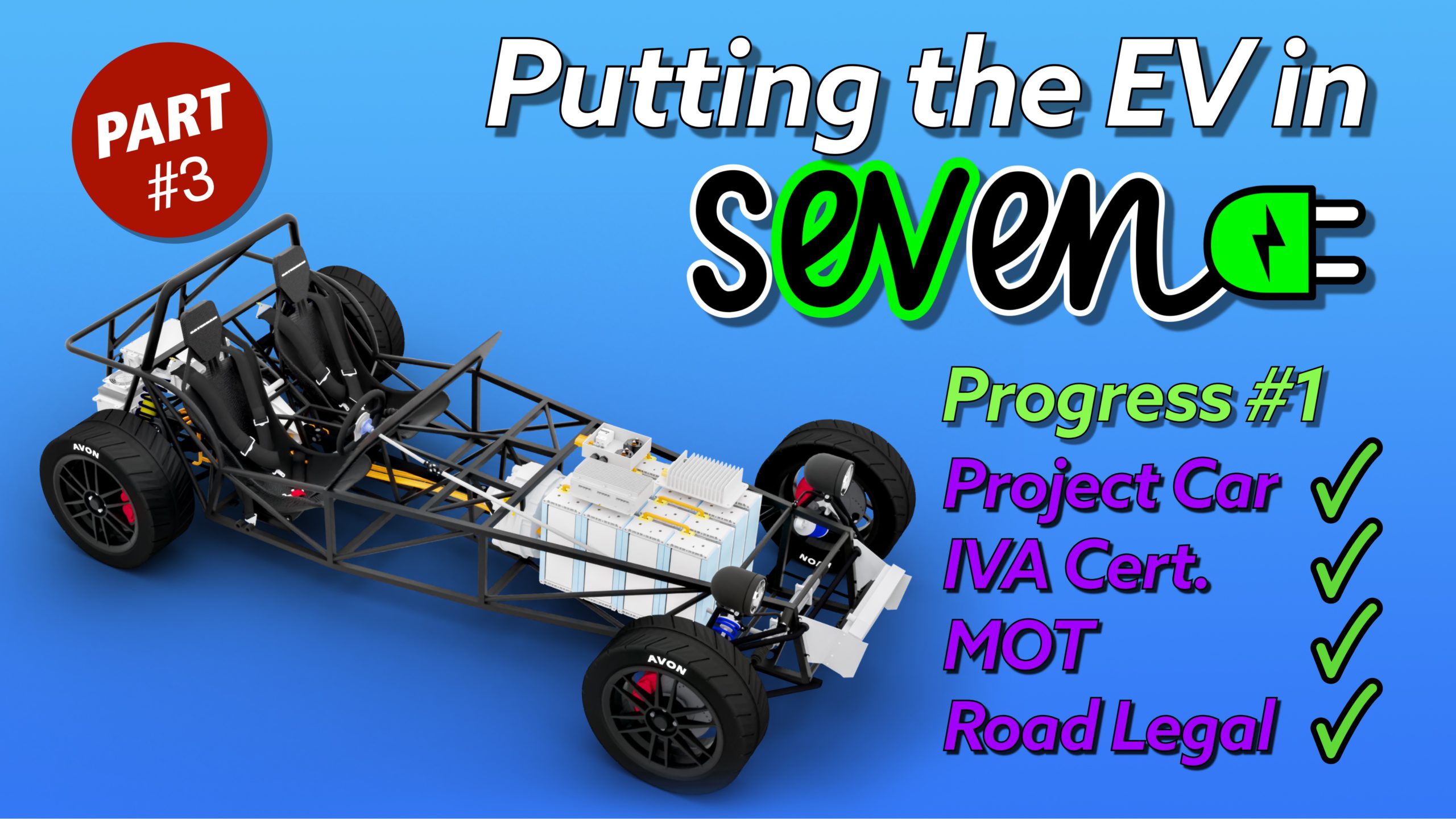
Well this video wasn’t quite the mammoth effort that the last two “explainer” videos were, but it still took over 50 hours to make.
The video covers the purchase and road registration of the project car from 2022 through to the spring of 2023. I cover the options for getting the car road registered and some of the fun in getting it MOT’ed.
You can find the video below:
The next video in this series will cover the strip down of the car to get it ready for 3D scanning.
Video Chapters
- [00:00] Introduction
- [01:04] Purchase
- [02:20] PT Sports Cars
- [03:39] What to do next
- [04:24] Options
- [04:38] DVSA and DVLA
- [05:17] What’s an MOT
- [05:58] What’s an IVA
- [06:57] R100
- [07:51] Road Registration Options
- [08:39] DVS Road Registration
- [10:57] MOT Preparation
- [12:11] DETOUR Project Scuttle
- [13:49] Back to fixing the electrics
- [14:19] Speedometer
- [15:15] Reversing Light
- [16:46] Finally MOT
- [18:38] Another MOT
- [20:15] Registration Plates
- [21:15] Wrap-up
Transcript
Introduction
[00:00] Hi, folks. Welcome to my rather untidy office. For this, the 1st progress video in my Putting the EV in Seven series. In this project, We’re taking an unloved 10 year old K-Trum 7 drift car and converting it to be an electric vehicle. Can we really take a classic 1957 designed, Caterham 7 pocket rocket, and turn it into a mean and green electric 7? Strap yourselves in for a few dozen reasonably raw videos over the next year or two. My antics in trying to get this minimalist EV conversion done.
[00:31] If you haven’t seen any of the previous videos, Then you can find a link to the playlist up here in the corner somewhere. But back to my project’s progress, and what’s the best way of taking my case room 7 and converting it to B an EV. Well, it turns out. that the first milestone for my project car is to get it road registered as an internal combustion engine vehicle. Yes, that’s right. An ice vehicle.
Purchase
[01:06] Ever since building my Purple 7 in 2017. I’ve been telling people I was going to do an EV conversion. And so I’d been looking for a project car on and off ever since. Though it must be said, not really very seriously. But in 2022, I decided to put my money where my mouth was and to get going on a conversion project. And as described in the overview video, the project victing, I mean, donikar, needed not to be someone’s pride and joy.
[01:31] It also needed to be what’s known in the catering world as an SV, or wide body version of the car, which are about 10 centimeters wider than a regular or S37. The Pride and Joy thing is personal. I didn’t want to be responsible for taking a perfectly good car and destroying it. The wide body requirement should also probably be fairly obvious. It was so I had more space to work with. I was going to need all the help I could get, trying to package all the EV stuff I needed into one of the smallest cars on the road.
[02:00] It was then in the July of 2022. I was sent a link to 3 X drift cars being sold by PT Sports Cars. As drift cars, they clearly tick the box of not being someone’s pride and joy. And they also turned out to be the wide bodied SP versions as well. That’s both requirements ticked, and therefore deserve to visit.
PT Sports Cars
[02:21] PT has a sizable 7 operation, and I counted over 57s in PT’s workshop. Some for sale, some being serviced or repaired, and some being race prepared. The cars had been for sale for a few weeks, so by the time I got there, one car had gone, one was paid for, and being ready for an MOT, which left just one for sale. We’ll come back to MOTs in a minute. It was no surprise, then, that the best of the three cars had been sold first.
[02:48] It had a few dings and dents around the bodywork, and had clearly been driven over way too many drift circuit cones during its ten year life. But as far as I could tell, the chassis was straight, and that was pretty much all I needed for this Frankenstein of a project. So I kicked the tyres a bit, started the car up, and agreed a price reduction if I took it as is, and therefore not having them get it ready for an MOT.
[03:09] A couple of weeks passed before the stars aligned and PT could deliver the car. When it arrived, the delivery driver rightly. Didn’t want the hassle of taking his truck and trailer a bar road, so we offloaded at the bottom of the road, and I drove the car up to the house. And that was about all I could do with it. Because the car wasn’t MOT’d, I couldn’t drive it around to see what was wrong. and was technically only allowed on the road to drive it to the MOT testation on the day of a test.
What to do next
[03:40] Right. So I’m now the proud owner of a rather tired, unregistered, 10 year old, Caterum 7, 1.6 liter super sport. So what next? Well, my EV conversion plans were a bit fluid at this point and depended a lot on what car I ended up buying. And now that I’d ended up with an unregistered car, I decided that I had two routes to the final road legal EV conversion. Option one was to do the conversion first, and then submit the car as an EV for what’s known as an individual vehicle approval test or IVA.
[04:14] Once I had an IVA completed, I could then apply for road registration as an EV. Option two was to get the car road registered as an ICE car first, and then once that
Options
[04:24] was out of the way, I could do the EV conversion and request a change of drivetrain. Okay, I’ve thrown a lot of acronyms at you. It’s time for a sidetrack. What’s all this DVSA, DVLA, IVA, and MOT?
DVSA and DVLA
[04:40] Here in the UK, we have two government departments responsible for road vehicles. The DVSA. Or driver and vehicle standards agency. Are responsible for making sure a vehicle is designed and built to a road worthy standard through one of either homologation or IVA. And then for a vehicle to be tested annually in an MOT test. The DVLA, or driver and vehicle licensing agency, are then responsible for a vehicle being maintained and taxed through the road taxing and VED systems. Both departments have other responsibilities, but that’s all we’ll need to know about for the moment.
What’s an MOT
[05:18] In order for you to drive a car on UK roads, and after three years from new, the vehicle needs to have passed a yearly basic roadworthiness and emissions test known as an MOT. We still call this test the MOT, even though the Ministry of Transport has long since morphed into other government agencies, and the name has now become rooted in the British psyche, like tea, warm beer, and queuing. To get an MOT, you present your car to an authorized test center, often a local auto garage, and leave the car there for a couple of hours while their tests are done.
[05:48] Hopefully you pick the car up later with a pass certificate, or as is more likely the case with older cars. A list of things that need fixing before a retest.
What’s an IVA
[06:00] Next in our acronym, soup, we have an IVA, or individual vehicle approval, which is sort of a super MOT test to show that a new, low volume, or heavily modified vehicle is roadworthy. This is how small vehicle manufacturers, coach builders, Kit Car builders, and I think of all things hearst builders get their road worthiness certification, and therefore be allowed to drive on the public roads. For any vehicle, this process requires both a paper-based form filling exercise and an in-person test of the vehicle in one of the various test centers dotted around the country.
[06:32] Now, for Ktrum 7s, the critical part of this process is to provide a paper trail of the major components, like engines, gearboxes, differentials, et cetera. Okay, now a book. But. As well as the regular IVA paperwork and testing. For an EV, there’s another requirement for getting an IVA pass, and that’s R 100 compliance.
R100
[06:58] An R 100 is something I’m sure we’ll come back to in future videos. But it’s a test framework that’s really designed to be used by big car manufacturers to get their mass-produced EV models homologated. And to make sure their vehicles aren’t going to kill too many people on the roads. Well, at least no more than ice vehicles do anyway. R 100 compliance for homologation is pretty onerous, and entails things like crushing a few cars, dunking them in water to test they won’t become dangerous.
[07:24] But the government has also decreed that for low volume and one off IVA testing of an EV. You also need to have R 100 compliance. This can either be performed. By crushing and dunking your car. Which would be bonkers for me. Or you can choose to have an engineer’s report written. Now we’ve got a bit of the background out of the way. Let’s get back to which of the 2 routes to the road registration I’m going to go with. I think you can probably see where I’m going to be going here.
Road Registration Options
[07:52] So, option one, conversion followed by an IVA is a fairly simple process for a factory or homebuilt internal combustion engine catering, but not so much for an EV conversion. I’m designing the car with R 100 compliance at its core. So while an IVA and Engineers R 100 report will be possible if needed, it’s not my preferred option. So that was simple. Even though it was tempting to start the EV conversion by ripping out the ice drivetrain and plugging in all the new EV stuff straight away.
[08:23] Taking the blue pill, I mean option 2, getting the car MOT’d and road registered as an ice vehicle before starting the conversion was clearly going to be my best bet. That’s perhaps the boring option, but clearly it made a lot more sense for me.
DVS Road Registration
[08:40] Right then. Well, that all sounds simple. Just get the car registered as an ice car, and once that’s done, I can get going on the conversion. But not so fast, even getting an ice catering road registered also means it must have passed an IVA test at some point in its life. So, then, the first job was to do some digging and figure out what the history of this car actually was. I certainly didn’t have any proof of an IVA when I bought the car.
[09:06] And as I was doing the digging, I was contacted. Through Catrum’s archivist, Martin Phipps. By the owner of one of this car’s sister cars. They were going through the same process and wanted to chat, and I’m always up for a chat. To cut a long story short, it turned out that their car had been IVA tested when it was built by Caterum in 2013, and so somewhere, there should probably be an IVA certificate for my car, too. Now, back to Martin, the alchemist.
[09:33] This car had passed an IVA after it had been built. Then came the inevitable button, but nobody knew where the certificate was. Caterum hadn’t got a copy, and the original owners had long since passed the car onto another company, neither of which were able to find IVAs for cars they no longer earned. The next step was, therefore, to apply to DVSA for a copy IVA certificate. So I filled in and sent off the forms along with the processing fee and waited.
[10:02] But perhaps not surprisingly, the application was declined. They said they wouldn’t have records for certificates going back that far. That didn’t quite stack up. Surely they kept records for what cars have passed when. Anyway, I wasn’t about to start an argument. Crap. An IVA test is now starting to loom closer. Grr. However, while pondering what to do next, I then heard back from the sister car again. They had now managed to get a copy certificate, this time by supplying a letter from Martin.
[10:31] Cool. So Martin sent me the appropriate letter, and I resubmitted the application along with the check to cover the admin costs, and 2 weeks later, The copy certificate dropped through the letterbox. Hurrah. No need to do a costly and time consuming IVA. Few. But here comes another but. With this copy certificate, there was now a clock ticking. I had 6 months to get the car road registered before this new certificate lapsed again.
MOT Preparation
[10:59] Okay, so now I have 6 months to get the car on the road. The 1st step was for it to pass one of those MOT test that I talked about earlier. I now needed to roll my sleeves up, stop writing emails, and filling in forms, and start to figure out what didn’t work, and to get it fixed ready for an MOT. As long as all the lights, indicators, wipers, and other stuff work, and the car is mechanically sound, then you should be able to pass an MOT.
[11:24] There’s the small matter of an emissions test, but caterings do usually manage to squeak through. So that should be all okay. Right? So what didn’t work? Well, the list wasn’t too extensive. Indicators, headlights main and dipped, sidelights, fog light, no reversing light, speedo, brake fluid level, and hand brake light. The near side front wing was a bit dodgy, too, but I hope that wasn’t an MOT fail, so that could wait. So I rolled up my sleeves and got cracking. Well, sort of.
[11:54] The first issue I found was that it was rapidly becoming a major pain, literally. To diagnose electrical faults by laying sprawled in the footwells, prodding the multimeter up under the dash to see what was going on with the various electrical systems in the car.
DETOUR Project Scuttle
[12:13] So, my 1st cunning plan, by which I mean detour, was to remove the scuttle to get at the wiring more easily from above. And removing the scuttle was going to be better than a subscription to a chiropractic service. The scuttle on a 7 is pop riveted to the bulkhead. So to… Move it. There’s lots of drilling out of the rivets. And then, of course, Riveting it all back up again when you put it back together. But a lot of seven owners also modify the scuttle, so it can be easily removed and refitted.
[12:41] My plan was not to use a blanking plate and captive nuts. But replace them with a set of 3D printed widgets. Bonded to the rear of the bulkhead. And each containing a captive nut. That I could then bolt through into the scuttle. It only took a couple of hours to model and print the widgets. The whole process worked reasonably well. With some sicker flex holding the widgets in place. At this stage of the project, I also realized I needed another 3D printed widget to help me not set light to the house.
[13:08] Which is always something I try and pay attention to. And in this particular case, I needed to hold the now floating live battery cut-off switch away from the chassis where it could short and potentially get warmer than the local fire department would like. When I bought the car, it had the ignition switch removed and just started on the battery cutoff switch and the starter button.
[13:33] So out with the 3D cad and printer again, and I made a simple widget that held the cutoff switch, and which then bolted onto the chassis. Good job, John. But I was now getting close to the IVA certificate, expiry date, so I now had to crack on.
Back to fixing the electrics
[13:51] So back to the problems with my car. They turned out to be. Headlights, main, dipped, and sidelights were all missing a relay, and for some reason, were also missing the switches on the dashboard. Indicators, missing indicator unit. No fog light. Dashboard switch needed cleaning out. That was most of the electrics fixed, and just left one empty slot in the relay box for the cabin heater. Or so I thought.
Speedometer
[14:19] However, there were still a couple of problems, and the one issue that was probably going to be an MOT fail if spotted was the Speedo. Caterum have two ways to pick up the drivetrain revolutions and feed the electrical pulses to the speedo. The old way. is a pickup off the gearbox. And then the new modern way is a tessellated ring and hall effect center on the rear axle. The car had 1,108 miles on the odometer, not a lot, but probably meant there had been a working speedo at some point.
[14:48] Perhaps it was disconnected on purpose or just wasn’t refitted at a service. If you know why drift cars have their speedos disconnected, then let me know in the comments section below. I certainly didn’t want to take the gearbox out and get the speedo working. Or for that matter, take the rear suspension apart and fit the newer system. So with time running out, I decided I was going to have to wing this bit of the test.
[15:13] The final thing to get sorted.
Reversing Light
[15:14] With the reversing light. Which is checked at the MOT and is a test failure, if not working. The reverse light is activated. By a switch screwed into the housing of the gearbox. Put the car in reverse, and a circuit is made. Simple, right? Well, the switch wires weren’t even connected on my car. And when I took a closer look, I could see why. One of the switch connection posts… Had broken off. Probably during a service or something, and because drift cars don’t need reversing lights, nobody needed to fix it.
[15:41] So I ordered a rather expensive new one from Caterum. But when fitting it, I managed to break the same connection post again, leaving me with 2 identical broken switches. Grr. I did try and cobble something together. By soldering onto the shortened post. But it really needed braising. And I don’t do that. Yet. In the meantime, I found a cheaper supply of stock forward switches, and ordered a couple replacements. While waiting for the new switches, I did some quick tests shorting the various circuit connections.
[16:10] I even bought a wireless endoscope inspection camera. To see if the insides of the gearbox were damaged. Which would have been a disaster, by the way. At this point, I did think about fitting a switch to the dashboard to operate the reverse light manually. But the MOT regulations say the reverse light needs to operate when the gear is selected, and I wasn’t sure I could get away with this at the MOT test. Best to get it fixed. In the end, I got the whole thing to work reasonably reliably.
[16:37] It only needed to work once, and I just needed a bit of a following wind on the day of the test. With all that fixed, it was time for an MOT.
Finally MOT
[16:48] So, apart from the speedo, I was ready. I have one sneaky drive around the block the day before the MOT and all seem to be running, even if it wasn’t right. The suspension did seem to be bottoming out pretty badly. But that wasn’t an MOT failure, and could definitely be filed under Problems for Future John. On the day though, it was wet. I turned up to the test station with it looking like rain, and then it did. I’d left the car running on the fore court.
[17:15] In the hope that the warm engine would pass an emissions test more easily. But when it started to rain, I just had to leave it steaming and getting drenched. Then all of a sudden, there was a lot more steam than there should have been. Oh no!
[17:32] The colon system had bowled over. Crap. Well, with the rain pouring down, The reason for the overheat wasn’t immediately obvious. So I decided discretion was the better part of valor, and I retreated home. I’ve been poring over the wiring diagrams. For a few weeks at this point. Trying to get a grip on the variously non-working electrics. And in my musings, I had spent a lot of time looking at the relays. However, when I’d read Coolant Fan, in my head, I heard Cabin Heater.
[18:00] Within a few minutes of hunting around the car that afternoon. Now that the rain had stopped. It was soon obvious what I’d done, and the penny dropped. Coolant fan relay. Didn’t mean… Cabin heater relay. No wonder the coolant fan wasn’t coming on to keep the engine cool. Duh. So, I robbed a relay from another fuse box slot and ran the car for a few minutes to test, making a mental note not to be so glib about reading wiring diagrams in the future.
[18:25] And as if by magic, when the car got hot, the coolant fan came on. Lo and behold, a fan is running. What an empty. Ah, well, at least that was an easy fix.
Another MOT
[18:40] Three days later, and it was off to the test center again. Okay, here we are. Second attempt at the MOT of this project car. It wasn’t raining either, so the gods were on my side this time, surely. Now. I’d chosen this test center for a few reasons. It was about the closest center to my house. So I meant I didn’t have far to walk. If things went badly wrong. But more than that, the guy running the station seemed pretty pragmatic. And was used to dealing with cars that were, shall we say?
[19:05] Towards the end of their economically viable lifetime. But even more critical was that, He wouldn’t fit in the car. And as I really needed the tester not to see the non-working Speedo, having someone, Who needed me to sit in the car. And operate the stuff that might or might not work during the test was perfectly fine by me. This time, the test went flawlessly. It did take a few goes to get the car through the emissions test, but as long as it passed, I wasn’t worried about that, seeing as this engine was coming out almost immediately after I got the car registered.
[19:38] And because the speedo not working is only a failure, if it’s… Observed. By the tester, then I got a pass. Few. Off home now to do some more paperwork. Hello, editor John here, just wanted to make it absolutely clear that I’m in no way condoning trying to cheat the MOT system. This was a very specific issue for a car I knew I wouldn’t be using after passing the MOT test. Also want to make it clear that when the only time I took the car out after passing the MOT test, I had a phone-based GPS speedometer running at all times.
Registration Plates
[20:16] I could now submit the registration forms to DVLA for them to issue what’s known as a vehicle logbook or V5C. And then 2 weeks later, a letter from DVLA dropped through the letterbox. It had the heft of an envelope that contained a V5. Well, that was a relief. I could now start to think about doing the EV conversion for real. Eight months had now passed since I bought the car, and I’d been hoping to have it MOT’d in just a few weeks.
[20:40] Unfortunately, that seems to have been a trend for this project. But those are musings for another day. I duly went out and bought some registration plates. So that I could take the car out for a last time ICE drive. To the local Caterum Club meeting that week. It will be some time before I could drive the car again. So the least I could do was take it out for a spin before pulling its guts out. The ride to the meetup was a real bone shaker.
[21:04] There was something seriously wrong with the way the suspension was set up. Avoiding trips to the dentist after a run in the car was clearly going to be another problem for future John.
Wrap-up
[21:16] So that’s it for this progress video. We’ve got a project car purchased, tick. IVA certificate acquired. Tick. MOT passed, tick. And it’s registered for road use, tick. The next job is to get the car stripped down ready for a scan, and no, that’s not some form of pregnancy test. I actually need a 3D scan of the car. So I can work out where I stand at least some semblance of a chance of fitting all the EV stuff in that I’m going to need.
[21:45] There’s clearly a reason why you don’t see the EV conversion companies offering the 7 conversions. But I have some cunning plans to fix all of that. But for now, that’s it for this episode. Like and subscribe to see more videos when they come out, and as always, stay safe and happy blatting.

Leave a Comment